Grid Representation
PyPSA-inspired transmission network modeling with intelligent spatial clustering
VerveStacks creates realistic transmission network representations by extracting and processing OpenStreetMap (OSM) infrastructure data, applying intelligent clustering algorithms, and integrating renewable energy zones with transmission connectivity. This approach generates PyPSA-compatible network models that balance geographic realism with computational tractability.
Grid Modeling Philosophy
VerveStacks transforms raw transmission infrastructure data into aggregated/filtered network representations suitable for energy system optimization. Rather than using simplified radial networks or generic templates, the platform processes actual transmission line and substation data to create country-specific grid models that reflect real-world topology and constraints.
Core Principles:
Geographic Realism: Networks based on actual transmission infrastructure locations
Computational Efficiency: Intelligent clustering reduces model complexity while preserving essential connectivity
Technology Integration: Seamless connection of renewable energy zones to transmission buses
Scalable Complexity: Adaptive clustering based on country size and infrastructure density
Data Foundation
OSM Infrastructure Data
The grid modeling process begins with comprehensive OpenStreetMap data extraction:
Transmission Buses (Substations): - High-voltage substations and switching stations - Coordinate validation and country assignment - Voltage level classification and filtering - Capacity and operational status where available
Transmission Lines: - High-voltage transmission corridors - Geographic routing and distance calculation - Voltage level and capacity specifications - Cross-border interconnection identification
Data Quality Assurance: - Coordinate bounds validation by country - Missing data identification and logging - Cross-dataset capacity reconciliation - Geographic consistency verification
Multi-Resolution Clustering Framework
VerveStacks employs a sophisticated multi-resolution approach to create transmission networks that balance detail with computational efficiency.
Bus Clustering Methodology
DBSCAN Spatial Clustering: - Algorithm: Density-Based Spatial Clustering of Applications with Noise - Purpose: Reduce bus count while preserving network topology - Parameters: Configurable clustering distance (typically 10-50 km) - Advantage: Handles irregular geographic distributions and identifies isolated nodes
Clustering Process: 1. Coordinate Projection: Transform to appropriate distance-based coordinate system (EPSG:3035) 2. Density Analysis: Identify bus clusters based on spatial proximity 3. Centroid Calculation: Compute representative locations for each cluster 4. Capacity Aggregation: Sum transmission capacities within clusters 5. Connectivity Preservation: Maintain essential network topology
Load Distribution Overview
Once clustered buses exist, national electricity demand is attributed to them via a dedicated allocation pipeline. Because that pipeline is substantial, it is described in its own section below — see Demand Allocation to Grid Nodes.
Demand Allocation to Grid Nodes
Spatially distributing national electricity demand across transmission-network buses
Once the transmission network has been clustered into a tractable set of buses, national electricity demand has to be attributed to those buses so that the optimisation model dispatches generation to where load actually sits. VerveStacks performs this attribution at the physical transmission-network level — loads land on high-voltage substation clusters, not on administrative units.
Design Intent
The spatial allocation deliberately ignores administrative boundaries (states, prefectures, oblasts, provinces). The unit of aggregation is the high-voltage substation cluster, because that is the physical injection point where transmission-level demand appears on the grid.
Consequences of this choice, stated explicitly:
Not every administrative subdivision will have its own demand node. A sub-national region whose load is physically served by a substation across its border will be represented at that substation. This mirrors how the real grid works and is a feature, not an omission.
Regions with no transmission-level infrastructure have no demand node at all. If a sub-national region contains no substation at or above the voltage threshold, its load is absorbed by the nearest eligible bus in a neighbouring region.
A long tail of small-share buses is intentionally discarded. The allocation keeps the major load centres per country rather than spreading demand uniformly, because uniform spreading (a) inflates the model without changing results and (b) obscures where congestion actually binds.
Users who need administrative-level demand reporting should treat it as a post-processing layer on top of bus-level results, not as a constraint on the allocation itself.
Allocation Pipeline
The production pipeline (--grids kan | eur | cit) proceeds in three steps, implemented in 1_grids/extract_country_pypsa_network_clustered.py.
Step 1 — Electrical filtering
Buses from the clustered network are filtered to those capable of serving transmission-level load:
Minimum voltage:
min_voltage_kv = 110kVOperational status: buses flagged as under construction are excluded
Bus type: substation / load / generic bus types are preferred; generator-only and converter buses are avoided
Surviving buses receive a voltage capacity weight reflecting their role in the grid hierarchy:
Voltage (kV) |
Weight |
Role |
|---|---|---|
≥ 750 |
20.0 |
Extra-high voltage, major interconnection |
≥ 500 |
15.0 |
Extra-high voltage, bulk transmission |
≥ 380 |
10.0 |
High voltage, regional transmission |
≥ 220 |
5.0 |
High voltage, sub-regional |
≥ 150 |
2.0 |
Sub-transmission |
≥ 110 |
1.0 |
Lower transmission (baseline) |
< 110 |
excluded |
— |
Step 2 — Voronoi tessellation with population weighting
Voronoi cells are constructed around the filtered (strong) buses and clipped to the country polygon (Natural Earth ne_10m_admin_0_countries). Each city in worldcities.csv with population ≥ pop_min = 10 000 is assigned to whichever bus’s Voronoi cell contains it.
For each bus b, a voltage-weighted assigned population is computed as:
assigned_pop[b] = Σ over cities c in cell(b) of population(c) × voltage_weight(b)
so the same city contributes more to a 380 kV bus than to a 110 kV bus. An initial load share is then:
load_share[b] = assigned_pop[b] / Σ_b assigned_pop[b]
which sums to 1 across all strong buses.
Step 3 — Sparsification
The initial share is dense — every strong bus receives some load. Most of those buses are electrical transit nodes rather than real load centres, and carrying all of them into the TIMES model inflates it without improving fidelity. sparsify_voltage_connectivity_aware compresses the distribution onto the buses that matter most, electrically and in terms of demand coverage.
Each bus is ranked by a composite importance score:
composite_score[b] = load_share[b]
                     × voltage_weight[b]      ^ voltage_priority_factor
                     × connectivity_weight[b] ^ connectivity_priority_factor
where connectivity_weight is a logarithmic measure of how many transmission lines touch the bus (from {ISO}_clustered_lines.csv). Default exponents are voltage_priority_factor = 2.0 and connectivity_priority_factor = 1.5, so a meshed 380 kV substation in a large city outranks a radial 110 kV bus serving a similar population.
Buses are accepted in order of composite score until the cumulative raw load_share of accepted buses exceeds a coverage target (default coverage_target = 0.80), subject to the guardrails min_nodes = 10 and max_nodes = 300. Unselected buses are zeroed; the kept buses are renormalised so their shares sum to 1.
Note
The ranking metric (composite score) and the stopping metric (raw load_share) are intentionally different. The composite score picks electrically plausible load-serving buses; the raw-share coverage check guarantees that enough of the actual demand is retained. Using one metric for both would either over-represent electrically weak population clusters or stop early on high-voltage but low-demand transit substations.
Output file: 1_grids/output_{data_source}/{ISO}/{ISO}_bus_load_share_voronoi.csv with columns bus_id, load_share, voltage_kv, voltage_weight.
Grid Variant Summary
The specific allocation file consumed downstream depends on the --grids option passed to main.py:
|
File read by the pipeline |
Allocation method |
|---|---|---|
|
|
Voltage-aware Voronoi + sparsification (above) |
|
|
Distance-weighted assignment: cities influence multiple buses with distance² decay and a 100 km cap |
|
|
Direct cluster weights from the synthetic-grid demand clusterer |
The distance-weighted variant uses a looser voltage filter and does not apply voltage/connectivity-aware sparsification; it is better suited to simplified kanN models. Synthetic grids carry their own demand clusters and need no spatial allocation step.
Translation into the TIMES Model
grid_modeling.py::process_grid_data() turns the bus-level load_share values into three VEDA/TIMES artefacts, which excel_manager writes into the generated workbook:
Grid-node commodities (
~FI_COMMon thegridssheet): onee_<bus>commodity of typeELCper kept bus, atdaynitetimeslice level.Demand-technology topology (
~tfm_topins): a cross-join of kept buses × demand technologies fromVS_mappings.dem_techs. Every<tech>_<bus>process getse_<bus>added as an input commodity, so the bus feeds that demand tech.Demand flow bound (
~tfm_ins-at): for every<tech>_<bus>process, aFLO_MARK~lobound ofload_share × 0.98on the end-use commoditieselc_buildings,elc_transport,elc_industry,elc_roadtransport. The 0.98 factor leaves ~2 % headroom so that minor rounding and Voronoi edge effects do not make the LP infeasible.
Existing-stock attachments follow the same file: existing_stock_processor.py uses load_share > 0 to decide which buses receive replicated demand technologies via the subRES regions/incode mechanism.
Tuning Knobs and Known Limitations
The defaults target a reasonable balance of model size and demand coverage for OECD-style transmission networks. The main knobs, exposed in compute_and_save_bus_load_share_voronoi and sparsify_voltage_connectivity_aware:
pop_min(default 10 000) — raise for very dense urban systems, lower for countries whose largest towns are small.min_voltage_kv(default 110) — lower for networks that are predominantly sub-transmission.coverage_target(default 0.80) — raise toward 0.95 to retain more of the long tail; expect the model to grow.min_nodes/max_nodes(default 10 / 300) — hard bounds regardless of coverage.voltage_priority_factor(default 2.0),connectivity_priority_factor(default 1.5) — raise to bias selection further toward high-voltage meshed buses; lower (toward 0) to let raw population share dominate.
Known limitations users should be aware of:
Coverage is intentionally incomplete. By default, ~20 % of national demand — the long tail of small buses — is zeroed at step 3 and redistributed onto kept buses via renormalisation. Administrative regions whose only electrical presence is in that long tail will not receive a demand node.
Sub-110 kV countries need parameter changes. Countries or islands whose transmission is predominantly below 110 kV will have very few eligible buses under defaults and may fall back to equal shares.
Voronoi cells do not respect sub-national boundaries. A strong bus near a sub-national border absorbs cities from both sides. This is deliberate — the allocation is physical, not administrative — but it means population maps and demand maps will differ at sub-national scale.
Population is the sole proxy. Industrial load concentrations (steel, refining, data centres) are not located explicitly; they are captured only to the extent they correlate with urban population. Sector-specific proxies are an experimental feature (see the New Zealand study under
Miscellaneous/output_sectoral_bus_demand/) and are not part of the main pipeline.
See also
- Demands and Prices
National-level demand and price trajectories that are subsequently spread across buses using the shares described here.
Transmission Line Modeling
Network Topology Construction
Line Geometry Processing: - Source Data: OSM transmission line geometries or bus endpoint connections - Validation: Coordinate bounds checking and topology verification - Simplification: Straight-line approximations between bus clusters - Capacity Estimation: Distance-based transmission capacity calculations
Connectivity Matrix: - Bus-to-Bus Connections: Direct transmission links between clustered buses - Cross-Border Lines: International interconnection modeling - Redundancy Analysis: Multiple parallel line aggregation - Islanding Prevention: Connectivity validation and isolated node identification
Network Transfer Capacity (NTC)
Realistic Capacity Estimation: - Geographic Distance: Line length calculation using great circle distance - Voltage-Based Scaling: Capacity estimation based on voltage levels - Parallel Line Aggregation: Multiple circuits between same bus pairs - Thermal Limits: Conservative capacity assumptions for reliability
NTC Calculation Methodology: - Base Capacity: Standard MW/km transmission capacity by voltage level - Distance Adjustment: Linear scaling with transmission line length - Reliability Margin: Conservative derating for operational security - Seasonal Variations: Temperature-dependent capacity adjustments where applicable
Renewable Energy Integration
RE Zone Connectivity
Technology-Specific Cluster Integration:
VerveStacks implements separate clustering for each renewable technology, creating distinct cluster sets that connect independently to the transmission network:
Solar PV Clusters: Independent clustering of solar grid cells with aggregated capacity potential
Wind Onshore Clusters: Separate clustering of onshore wind grid cells with capacity-weighted profiles
Wind Offshore Clusters: Dedicated offshore wind clustering (where applicable) with marine grid connectivity
Cluster Composition: Each cluster represents 10-300 individual 50x50km grid cells with combined MW potential
Capacity Aggregation: Total renewable potential calculated from REZoning data across constituent grid cells
Transmission Access Analysis: - Distance Calculation: Shortest path from renewable clusters to transmission buses (≥150kV) - Connection Costs: Distance-based transmission line construction costs per technology cluster - Capacity Constraints: Transmission capacity limits for renewable integration by technology type - Grid Code Compliance: Technical requirements for renewable energy connections
Cluster-to-Bus Assignment Process: 1. Technology Separation: Solar, wind onshore, and wind offshore processed independently 2. Spatial Assignment: Each cluster assigned to nearest transmission bus using great circle distance 3. Capacity Weighted Profiles: Hourly capacity factors aggregated using grid cell capacity as weights 4. Economic Integration: Distance-based connection costs (M$/GW-km) calculated per cluster 5. Profile Integration: Technology-specific hourly generation profiles linked to transmission nodes 6. Curtailment Modeling: Transmission-constrained renewable energy dispatch by technology
Technology Connection Methodology
VerveStacks implements sophisticated algorithms for connecting both existing and new generation technologies to transmission buses, ensuring realistic grid access while maintaining computational efficiency.
Renewable Energy Cluster Integration
Technology-Specific Clustering Approach:
VerveStacks processes renewable energy resources through independent clustering for each technology, creating optimized spatial aggregations that preserve resource characteristics while enabling efficient grid integration:
Cluster Formation Process: 1. Grid Cell Processing: Extract 50x50km renewable energy grid cells from REZoning database 2. Technology Filtering: Apply capacity factor thresholds (>5% solar, >8% wind) to exclude low-quality resources 3. Independent Clustering: Perform hierarchical clustering separately for solar, wind onshore, and wind offshore 4. Capacity Aggregation: Sum installed capacity potential (MW) across grid cells within each cluster 5. Profile Weighting: Calculate hourly capacity factors using grid cell capacity as weights 6. Bus Assignment: Connect each cluster to nearest transmission bus (≥150kV) using great circle distance
Cluster Characteristics: - Dynamic Sizing: 10-300 clusters per technology based on country size (n_clusters = n_cells^0.6) - Capacity Basis: Each cluster capacity derived from REZoning grid cell potential aggregation - Profile Generation: Hourly capacity factors weighted by constituent grid cell capacity (MW) - Geographic Representation: Clusters maintain spatial coherence while optimizing grid connectivity - Technology Independence: Solar and wind clusters formed separately to avoid cross-technology interference
Grid Integration Outputs: - Technology-Specific Commodities: Separate VEDA commodities for solar (elc_spv), wind onshore (elc_won), wind offshore (elc_wof) - Cluster-Specific Profiles: Individual hourly capacity factor profiles for each renewable cluster - Connection Economics: Distance-based transmission costs and losses calculated per cluster - Transmission Mapping: Each cluster assigned to specific transmission bus with capacity and profile data
Existing Power Plant Assignment
Geographic Proximity Algorithm: - Nearest Bus Assignment: Each power plant connected to geographically closest transmission bus - Haversine Distance Calculation: Great circle distance using Earth’s radius (6,371 km) - BallTree Spatial Indexing: Efficient nearest neighbor search for large plant datasets - Coordinate Validation: Automatic removal of plants with missing geographic coordinates
Assignment Process: 1. Data Preparation: Clean plant coordinates and bus locations 2. Spatial Indexing: Build BallTree with bus coordinates in radians 3. Distance Calculation: Query nearest bus for each power plant location 4. Mapping Creation: Generate plant-to-bus assignments with distance metrics 5. Deduplication: Remove duplicate plants (keeping first occurrence by GEM location ID)
Quality Metrics: - Average Connection Distance: Typical 15-50 km depending on grid density - Maximum Connection Distance: Validates reasonable grid access assumptions - Bus Voltage Compatibility: Ensures plant capacity matches bus voltage level
New Technology Integration
Technology-Specific Renewable Energy Connections: - Cluster-to-Bus Mapping: Technology-specific renewable clusters assigned to transmission buses - Solar Cluster Assignment: Solar clusters connected to nearest transmission buses with solar-specific profiles - Wind Cluster Assignment: Wind onshore and offshore clusters connected independently with wind-specific profiles - Spatial Join Priority: Clusters within transmission zone boundaries get direct bus assignment - Nearest Bus Fallback: Clusters outside zones connected to closest transmission node (≥150kV) - Capacity Aggregation: Technology-specific renewable potential calculated per bus from assigned clusters - Profile Aggregation: Capacity-weighted hourly profiles generated for each technology at each bus
Technology-Specific Connection Cost Modeling: - Cluster-Based Costs: Transmission line construction costs calculated per renewable technology cluster - Distance Calculation: Great circle distance from cluster centroid to assigned transmission bus - Technology Independence: Solar, wind onshore, and wind offshore clusters costed separately - Grid Code Compliance: Technical requirements applied per technology type - Capacity Constraints: Transmission capacity limits assessed for each technology cluster - Curtailment Assessment: Technology-specific transmission-constrained dispatch potential
Economic Assumptions (Per Technology Cluster):
- Connection Cost: $1.1 million per MW-km for high-voltage transmission infrastructure per cluster
- Transmission Losses: 0.6% per 100 km (6% per 1,000 km) following industry standards for AC transmission
- Cost Formula: ncap_cost = 1.1 × cluster_distance_km (M$/GW-km per technology cluster)
- Efficiency Formula: efficiency = 1 - 0.00006 × cluster_distance_km (0.006% loss per km per cluster)
- Capacity Basis: Cluster capacity derived from aggregated REZoning grid cell potential (MW)
Conventional Technology Siting: - New Plant Placement: Future conventional plants assigned using same nearest-bus algorithm - Technology-Specific Constraints: Coal, gas, nuclear plants consider cooling water access - Transmission Adequacy: Ensure sufficient transmission capacity for planned generation - Geographic Realism: Respect land-use constraints and environmental restrictions
VEDA Syntax Integration: VerveStacks creates “buses to attach” dataframes that specify where new technologies can be deployed:
Thermal Buses: Coal, gas, nuclear plants above capacity thresholds (typically 50-100 MW)
Hydro Buses: Hydro plants above technology-specific thresholds
Storage Buses: All storage technologies above capacity thresholds
Demand Buses: Load centers with non-zero demand allocation
These dataframes use ~replicateinregions VEDA syntax to automatically replicate new technology options at specific transmission buses, enabling geographically-realistic capacity expansion planning.
Multi-Technology Bus Assignment
Clustering Integration: After bus clustering, all technology assignments are updated to maintain connectivity:
Cluster Mapping: Original plant-bus assignments mapped to cluster representatives
Capacity Aggregation: Multiple plants at clustered buses have combined capacity
RE Cluster Integration: Technology-specific renewable clusters assigned to transmission buses
Profile Integration: Capacity-weighted hourly generation profiles linked to transmission nodes per technology
Load Balance: Ensure generation-demand balance at each clustered bus including renewable clusters
Assignment Validation: - Connectivity Verification: All technologies reachable through transmission paths - Capacity Consistency: Plant capacity compatible with bus voltage and transmission access - Geographic Reasonableness: Connection distances within realistic ranges - Load-Generation Balance: Regional supply-demand consistency maintained
Load Flow Considerations: - Generation-Load Balance: Regional supply-demand matching - Transmission Constraints: Power flow limits and congestion analysis - Operational Flexibility: Ramping rates and minimum generation levels - Ancillary Services: Frequency regulation and voltage support capabilities
Model Output and Validation
PyPSA Network Files
Standardized Format: - Buses DataFrame: Transmission nodes with coordinates and load assignments - Lines DataFrame: Transmission connections with capacity and impedance - Generators DataFrame: Power plants with technical and economic parameters - Loads DataFrame: Demand time series by transmission bus
Quality Metrics: - Network Connectivity: All buses reachable through transmission paths - Load-Generation Balance: Regional supply-demand consistency - Transmission Adequacy: Sufficient capacity for expected power flows - Geographic Realism: Network topology consistent with actual infrastructure
Network Visualization Examples
VerveStacks generates comprehensive network visualizations that demonstrate the voltage filtering and clustering methodology. These examples show how different grid definitions create models optimized for multi-period optimization with fine timeslices.
Germany: Voltage Filtering Comparison
The comparison between EUR and KAN grid definitions for Germany illustrates the voltage filtering approach:
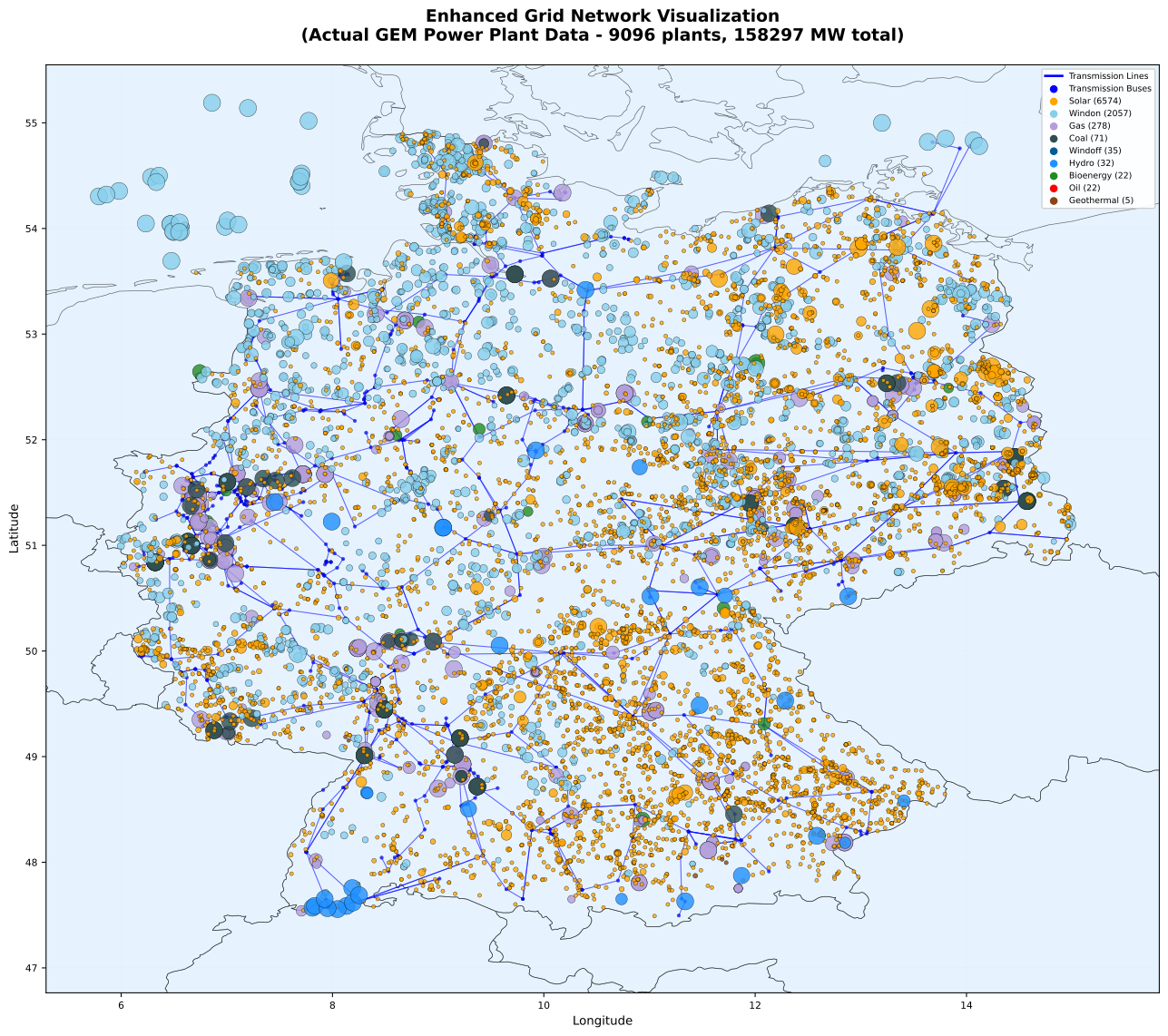
Germany Transmission Network - EUR Grid Definition (795 buses, 1,029 lines)
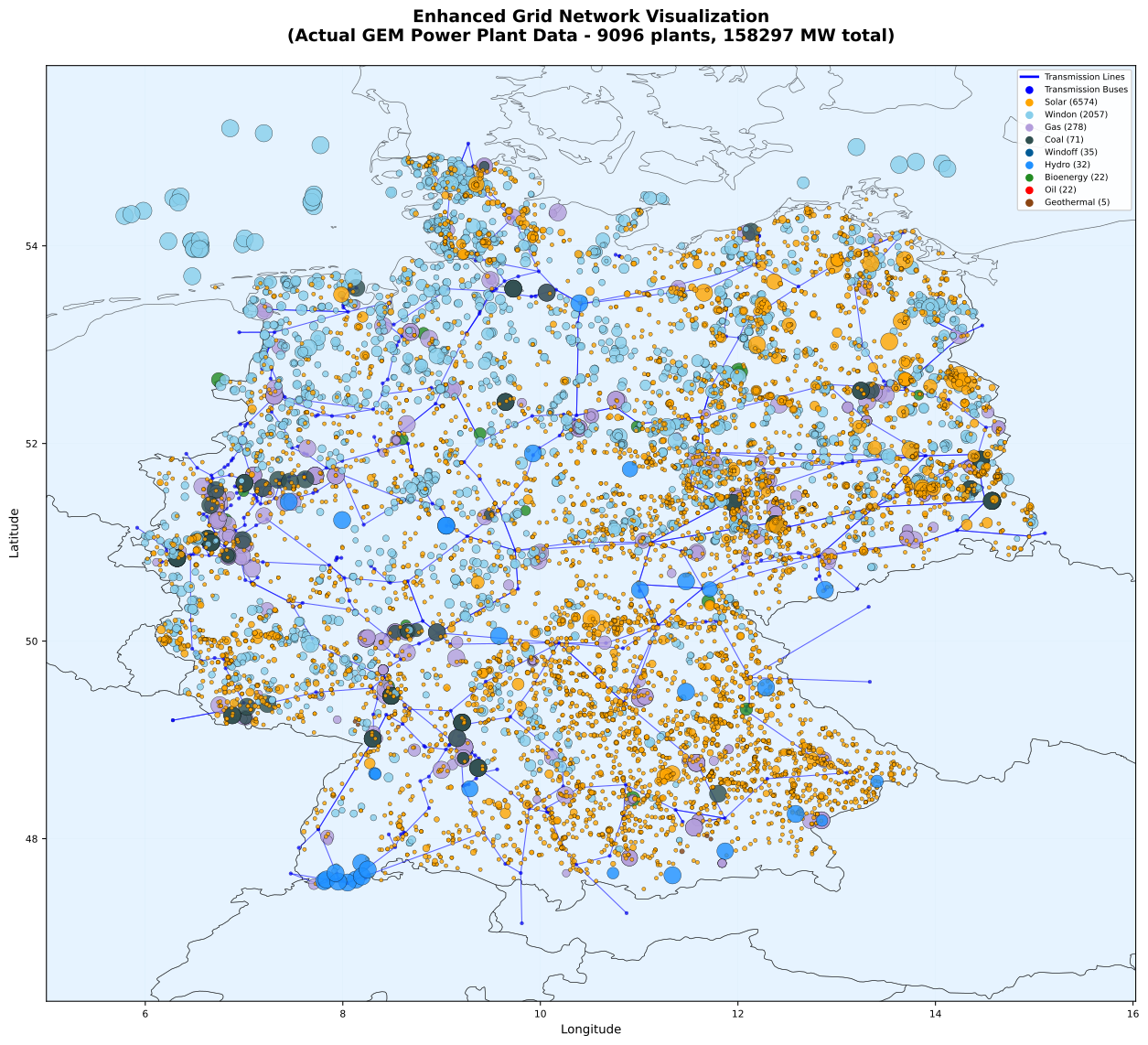
Germany Transmission Network - KAN Grid Definition (481 buses, 671 lines)
The EUR grid captures detailed high-voltage infrastructure, while the KAN grid applies voltage filtering to create a coarser network suitable for responsive multi-period optimization. This filtering achieves a 39% reduction in buses (795→481) and 35% reduction in lines (1,029→671), significantly reducing model complexity while preserving essential transmission corridors and connectivity patterns.
Additional Country Examples
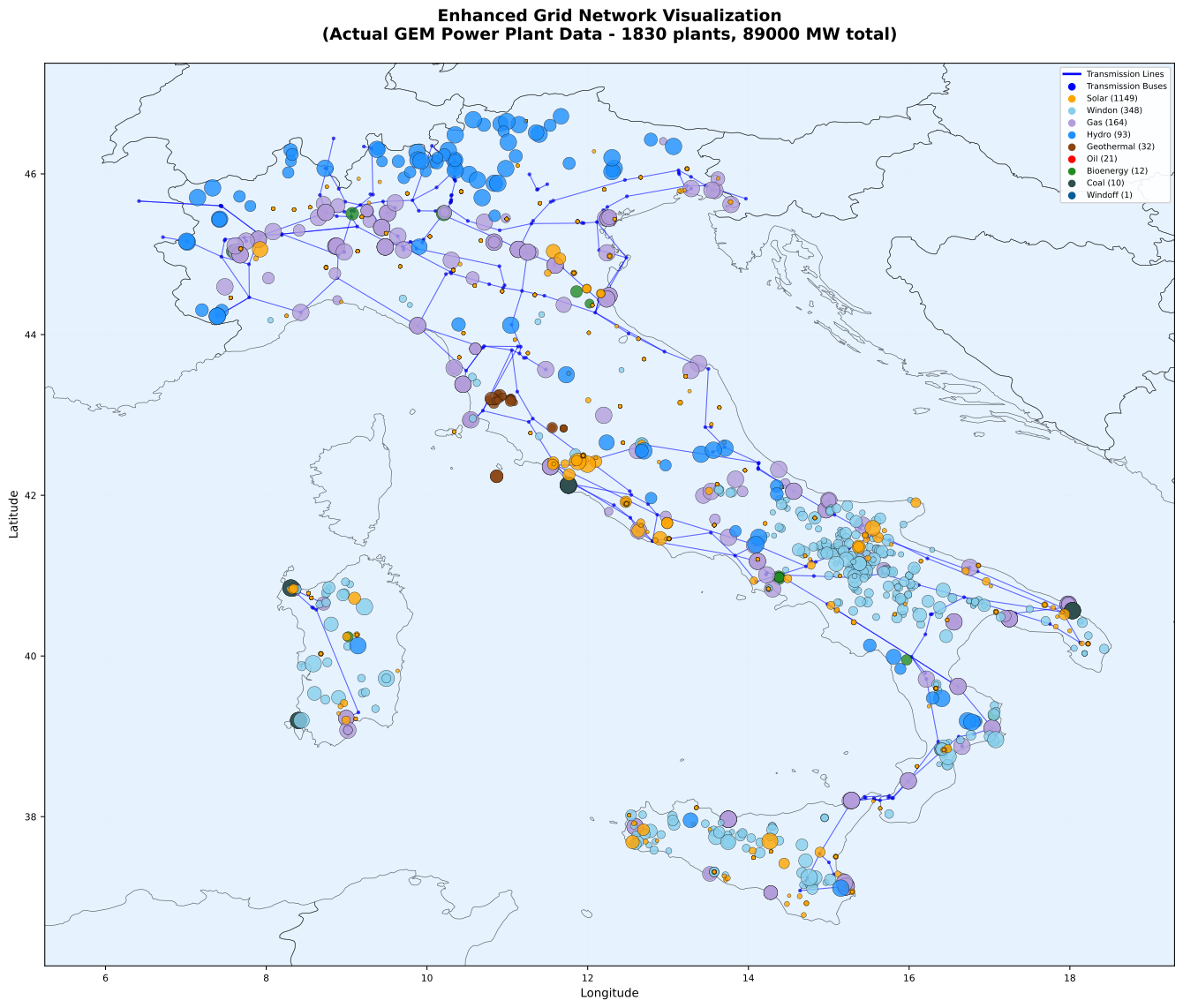
Italy Transmission Network - Optimized for Energy System Modeling (265 buses, 365 lines)
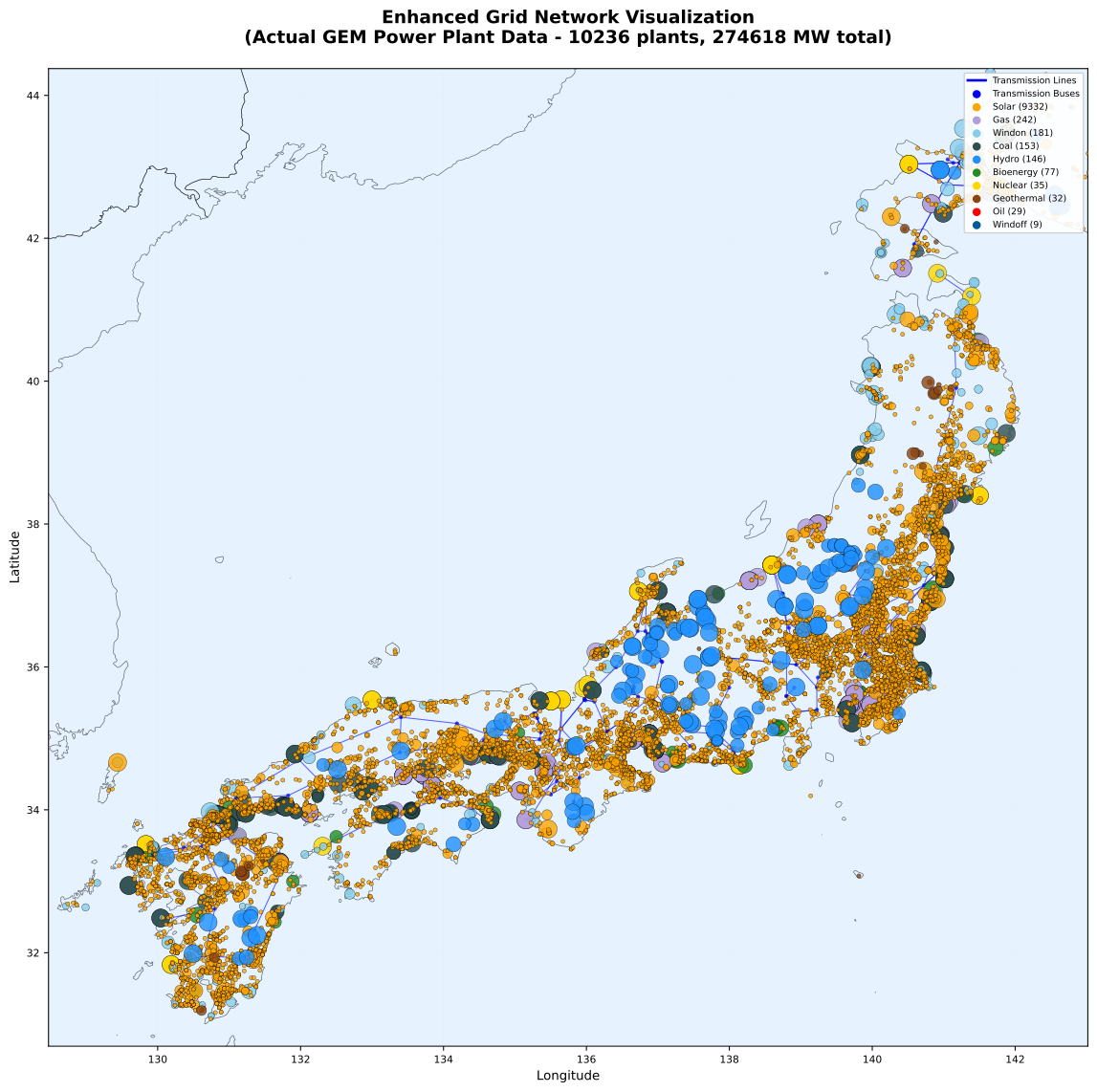
Japan Transmission Network - Island Grid with Inter-Regional Connections (187 buses, 237 lines)
These visualizations demonstrate how VerveStacks adapts the grid modeling approach to different geographic and infrastructure contexts:
Italy: Continental network with strong north-south transmission corridors
Japan: Island nation with distinct regional grids and limited interconnections
Voltage Filtering Methodology:
The transition from detailed (EUR) to optimized (KAN) grid representations involves:
Low-voltage elimination: Removal of distribution-level infrastructure
Strategic clustering: Aggregation of nearby substations while preserving topology
Capacity preservation: Maintenance of total transmission capacity through parallel line aggregation
Connectivity validation: Ensuring all regions remain electrically connected
This approach enables VerveStacks models to achieve computational efficiency necessary for fine timeslice resolution (up to 8760 hours) and multi-period investment optimization while maintaining geographic realism in transmission constraints.
Validation Outputs
Connectivity Analysis: Network topology and islanding assessment Capacity Utilization: Transmission line loading and bottlenecks Renewable Integration: RE zone accessibility and grid connection costs Model Statistics: Bus count, line count, and network complexity metrics
Technical Implementation
Computational Efficiency
Adaptive Clustering: - Country-Specific Parameters: Clustering distance based on country size and infrastructure density - Complexity Management: Target bus counts for computational tractability - Quality Preservation: Essential connectivity maintained through clustering process - Scalability: Consistent methodology across countries from Switzerland to China
Performance Optimization: - Spatial Indexing: Efficient geographic queries using spatial data structures - Parallel Processing: Multi-threaded clustering and connectivity analysis - Memory Management: Optimized data structures for large-scale networks - Caching: Intermediate results stored for iterative model development
Integration with Energy System Models
VEDA Model Integration
Network Parameters: - Transmission Capacities: NTC values for inter-regional power trade - Investment Options: Transmission expansion possibilities and costs - Operational Constraints: Power flow limits and stability requirements - Regional Definitions: Transmission zones for energy system optimization
Technology-Specific Renewable Energy Supply: - Solar Cluster Mapping: Solar PV clusters connected to transmission buses with solar-specific profiles - Wind Cluster Mapping: Wind onshore and offshore clusters connected independently with wind-specific profiles - Cluster Capacity: Each cluster represents aggregated MW potential from 10-300 grid cells (50x50km each) - Weighted Profiles: Hourly capacity factors calculated using grid cell capacity as weights - Access Costs: Grid connection expenses calculated per technology cluster based on distance to transmission - Technology Separation: Independent curtailment analysis for solar, wind onshore, and wind offshore - Storage Integration: Battery and pumped hydro storage siting optimization per renewable technology
Real-World Applications
Grid Planning Studies
Transmission Expansion: - Bottleneck Identification: Transmission constraints limiting renewable integration - Investment Prioritization: Cost-effective transmission upgrade strategies - Cross-Border Trade: International interconnection development - Grid Modernization: Smart grid infrastructure deployment
Renewable Integration Analysis: - Hosting Capacity: Maximum renewable energy integration by transmission zone - Grid Stability: Voltage and frequency regulation with high VRE penetration - Storage Requirements: Grid-scale energy storage for renewable energy balancing - Flexibility Services: Demand response and sector coupling opportunities
Policy and Market Analysis
Energy Security: - Supply Diversity: Geographic distribution of generation resources - Import Dependence: Reliance on cross-border electricity trade - Critical Infrastructure: Transmission system resilience and redundancy - Emergency Response: Grid restoration and blackout prevention
Market Design: - Nodal Pricing: Locational marginal pricing and congestion management - Transmission Rights: Financial transmission rights and capacity allocation - Grid Services: Ancillary services markets and system operation - Regulatory Framework: Transmission access and grid code compliance
Conclusion
VerveStacks grid representation methodology transforms complex transmission infrastructure data into practical network models suitable for energy system analysis. By combining geographic realism with computational efficiency, the platform enables sophisticated grid planning and renewable integration studies while maintaining model tractability.
The multi-resolution clustering approach ensures that essential network characteristics are preserved while reducing computational complexity. Integration with renewable energy zones and existing power plants creates comprehensive models that support policy analysis, investment planning, and operational studies across diverse geographic and regulatory contexts.
Through systematic processing of OpenStreetMap data and intelligent spatial clustering, VerveStacks democratizes access to professional-grade transmission network modeling, enabling users worldwide to conduct sophisticated grid analysis without requiring specialized infrastructure modeling expertise.
Note
Grid modeling outputs include interactive network visualizations and comprehensive validation metrics for model verification and quality assurance.